
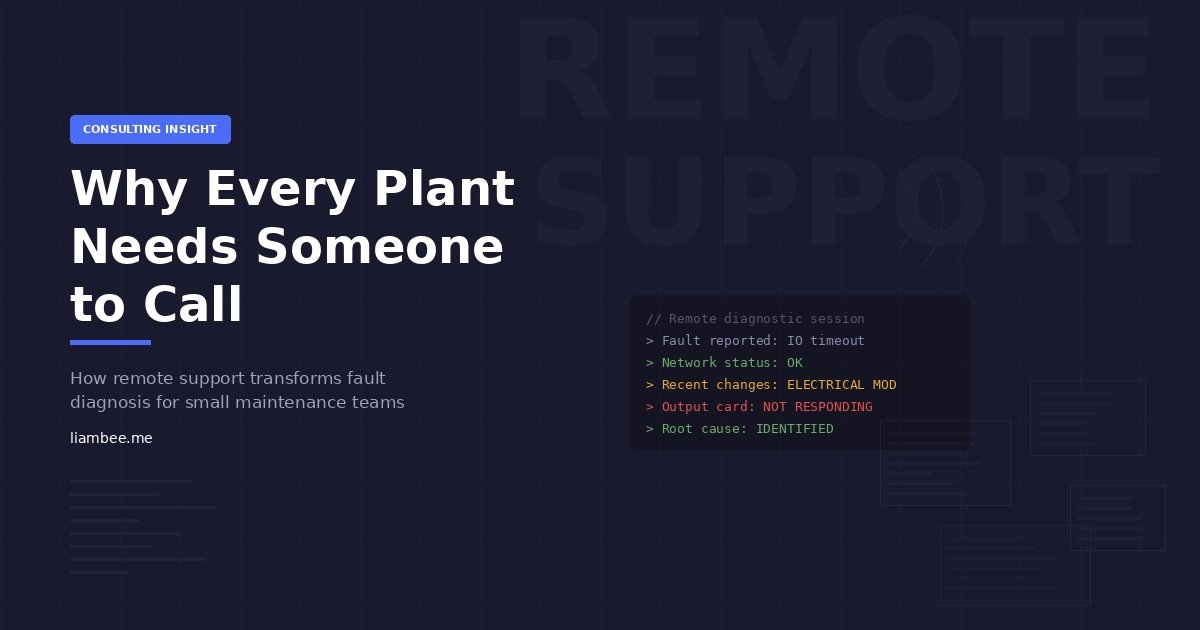
How access to experienced remote support can transform the way small teams handle automation faults, reduce downtime, and avoid costly misdiagnosis.
The Moment Everything Stops
There is a particular kind of silence that falls over a production floor when a PLC stops behaving the way it should. Operators notice it first. Inputs that should trigger outputs are being ignored. Sequences that ran fine yesterday are now stuck mid-cycle. The maintenance light is on, but the fault log is vague. Something is wrong, and nobody on site is entirely sure what.
For larger organisations with dedicated automation teams, these moments are disruptive but manageable. Someone walks over to the engineering office, opens the project on their laptop, connects to the PLC, and starts working through the diagnostics. Within the hour, they have a theory. Within the day, they usually have a fix.
But most manufacturing plants do not operate like that. The reality for a significant number of facilities across the UK is that the person responsible for keeping the automation running is also responsible for mechanical maintenance, electrical work, building services, and half a dozen other things that demand their attention on any given day. PLC programming sits somewhere on their skill list, but it sits alongside so many other responsibilities that deep diagnostic work becomes a luxury they rarely get time for.
When something goes wrong with the control system in that environment, the pressure is immediate and the options feel limited. Call the original integrator, who may or may not be available this week. Call the hardware supplier, who can tell you the card is healthy but cannot help with the application logic. Or spend the next two days working through the problem alone, pulling cable schedules, reading through code you did not write, and hoping you spot the issue before production falls further behind.
There is a better option, and it starts with having someone you can pick up the phone to.
Why Small Teams Get Stuck
The challenge facing small maintenance teams or lone engineers is rarely a lack of competence. Most of the people I speak to in these roles are sharp, practical, and experienced in their own right. They know their plant. They know their process. They have kept things running through situations that would have overwhelmed less capable people. The problem is perspective.
When you are the only person looking at a fault, every assumption you make early in the diagnostic process shapes everything that follows. If the first thing you notice is a network warning, you start thinking about network issues. If someone mentions the PLC was “freezing,” you start looking at scan cycle times and communication loads. These are reasonable starting points, and in many cases they lead to the right answer. But when they do not, you can spend hours or even days working down a path that was never going to reach the root cause.
This is not a reflection of skill. It is a reflection of how diagnostic thinking works when you are operating alone. Every engineer who has worked in automation long enough has experienced it. You become so focused on the trail you are following that you stop questioning whether the trail is the right one. The clues that would redirect your attention sit just outside your current frame of reference, and without someone to challenge your thinking, they stay there.
In a well-staffed engineering department, this problem solves itself naturally. You walk over to a colleague, explain what you have found so far, and within five minutes they ask a question you had not considered. “Have they done any work on site recently?” or “Have you checked whether the outputs are actually switching?” or “What changed between when it was working and when it stopped?” These are not complex questions. They are obvious questions. But they are obvious to the person who is not already three hours deep into a network diagnostic.
Small teams do not have that luxury. The lone engineer does not have a colleague to bounce ideas off. The maintenance team of two is often dealing with separate issues on the same day. The result is that faults which should take thirty minutes to find end up consuming an entire shift, sometimes longer, and the longer they take, the more pressure builds, the more assumptions get reinforced, and the harder it becomes to step back and reconsider.
The Value of a Different Perspective
I have lost count of the number of times a remote support call has followed the same pattern. Someone phones with a problem they have been working on for hours. They walk me through what they have found, what they have tried, and what they think is causing it. I listen carefully, ask a few questions about the history of the issue and what has been happening on site around the time the fault appeared, and within fifteen or twenty minutes we have either confirmed their theory or identified a completely different line of investigation.
The value in that exchange is not that I know something they do not. Often, the person on the other end of the phone knows their system far better than I ever will. They know which valves stick, which sensors drift, which parts of the process are temperamental. What I bring is distance. I am not three hours into their diagnostic trail. I have no preconceptions about what the fault might be. I can hear things in their description that they have stopped noticing because they have been staring at the same information all morning.
A recent example illustrates this well. A site called with what they believed was a network issue affecting their PLC. The scan cycle appeared to be misbehaving, almost as though the processor was ignoring operator inputs. The maintenance light was on, suggesting a minor fault, and the on-site team had been working through network diagnostics for some time, convinced that a communication problem was locking up the controller intermittently.
Walking through their diagnosis over the phone was revealing. Not because anything they had done was wrong, but because the conversation itself uncovered context that had been sitting in the background, unconnected to the fault in anyone’s mind. It emerged that maintenance activities had taken place on site recently, and those activities had involved electrical modifications. That single piece of information changed the entire direction of the investigation.
Rather than continuing to chase the network theory, we worked backwards from the modifications. What was changed? Where were the changes made? What sits downstream of those changes in the electrical architecture? Within minutes, the focus shifted to the IO, and it became clear that an output card was faulty. No outputs were being sent. The PLC was running its logic perfectly, processing inputs exactly as it should, but the results were never reaching the field devices because the card responsible for sending those signals was not functioning.
The whole call took about thirty minutes. In that time, we dismissed the suspected network fault through a structured elimination process, uncovered the history of events that had actually led to the problem, explored alternative fault paths based on experience and general discussion, and identified the faulty IO card. The on-site team felt confident that now they knew exactly where the problem was and what needed replacing, they could handle the rest themselves.
That is how remote support works at its best. It does not replace the on-site team. It amplifies them. It gives them access to a different way of thinking about the problem, a structured approach to elimination, and the kind of experience that only comes from seeing hundreds of different faults across dozens of different systems over twenty-plus years.
What Remote Support Actually Looks Like
There is a misconception that remote support means someone logging into your PLC from their office and poking around in the code. That can be part of it, certainly, and there are situations where remote access to the project is the fastest way to diagnose an issue. But a significant amount of effective remote support happens without any remote connection at all.
A phone call or a video call can be extraordinarily productive when both parties understand the process. The on-site person describes what they are seeing. The remote engineer asks targeted questions. Together, they build a picture of the fault that neither could have constructed alone. The on-site person provides the sensory data, the real-time observations, the physical context. The remote engineer provides the structured diagnostic approach, the experience of similar faults on other systems, and the ability to challenge assumptions without being emotionally invested in any particular theory.
Sometimes the most valuable thing a remote engineer does is tell someone to stop. Stop chasing the network. Stop replacing sensors. Stop rewriting logic. Step back and tell me what actually changed. That redirection, delivered by someone who understands both the technology and the pressure the on-site team is under, can save hours of wasted effort and thousands of pounds in unnecessary parts or contractor callouts.
Remote support also scales to the complexity of the issue. A straightforward fault might be resolved in a fifteen-minute phone call. A more complex problem might involve an initial call to understand the situation, followed by a review of documentation or screenshots sent by email, followed by a second call to work through a diagnostic plan. Occasionally, a fault is complex enough to warrant a remote connection to the programming environment, where the support engineer can observe PLC behaviour in real time while the on-site team operates the equipment.
The point is that the model is flexible. It adapts to what the situation requires, and it does so without the lead time, travel costs, and scheduling constraints that come with getting someone physically on site.
The Business Case for a Retainer
If you run a small operation with one or two maintenance staff, or if your facility relies on engineers whose primary expertise is mechanical or electrical rather than software, the question you should be asking is straightforward: what happens when the PLC goes wrong?
The honest answer for many plants is that nothing happens quickly. The on-site team does their best, but PLC faults are infrequent enough that they never build deep expertise in diagnosing them, and complex enough that guesswork is expensive. The integrator who built the system may still be available, but their response time is measured in days, not hours, and their callout rates reflect the urgency of your situation. Every hour of downtime costs money. Every misdiagnosis costs time. Every replacement part ordered on a hunch costs budget that could have been spent elsewhere.
A retainer model changes that dynamic entirely. For a predictable monthly cost, your team gains access to experienced automation support whenever they need it. No callout fees. No waiting for availability. No explaining your system from scratch to someone who has never seen it before. A retainer means the support engineer already knows your facility, your equipment, your control philosophy, and the history of issues you have dealt with. When you call, you can skip the introductions and get straight to the problem.
The financial argument is compelling when you look at the numbers. A single extended downtime event at most manufacturing facilities costs more than an entire year of retainer support. A single unnecessary integrator callout, with travel, day rates, and expenses, often costs more than several months of retained hours. And those are just the direct costs. The indirect costs of prolonged faults, including missed production targets, overtime for catch-up runs, quality issues from rushed restarts, and stress on your maintenance team, add up quickly and are rarely captured in any accounting system.
But the real value of a retainer goes beyond cost avoidance. It changes the way your team operates. Knowing that expert support is a phone call away changes behaviour. Engineers are more willing to investigate issues early rather than waiting until they become critical. They are more confident in their diagnostic approach because they know they can validate their thinking with someone experienced. Problems get caught earlier, diagnosed faster, and resolved more cleanly. The overall reliability of your automation improves, not because the equipment changed, but because the support structure around it changed.
What a typical retainer includes: A pool of pre-purchased support hours available on demand. Phone and video call diagnostics. Review of fault logs, screenshots, and documentation. Remote PLC access where connectivity allows. Familiarity with your specific systems built over time. Priority response during critical faults.
The Faults You Do Not See Coming
There is a category of automation fault that catches small teams out more than any other. These are not the dramatic failures where a drive trips, an alarm sounds, and the cause is immediately obvious. These are the slow, subtle, confusing faults where the system is still running but something is not right. Sequences are slower than they should be. Outputs are not responding the way they used to. An interlock is triggering when it should not be, or not triggering when it should.
These faults are maddening because they resist simple diagnosis. The PLC is not in fault. The network is healthy. The hardware diagnostics come back clean. Everything looks fine on paper, but the process is telling a different story. The on-site team starts questioning the sensors, then the wiring, then the logic, then the mechanical components, working through a list of possibilities that grows longer with every hour that passes without a clear answer.
This is where experience becomes the most valuable tool in the diagnostic toolkit. An engineer who has seen hundreds of different systems develop hundreds of different faults starts to recognise patterns that are invisible to someone seeing a particular failure mode for the first time. The way a PLC behaves when an IO card is partially failed. The symptoms that appear when a grounding issue develops gradually. The subtle signs that a recent modification has introduced an unintended side effect. These are not things you learn from manuals. They come from years of troubleshooting across a wide variety of applications and hardware configurations.
Remote support puts that experience within reach of teams who would otherwise have to develop it the hard way, through trial and error, on their own production equipment, under pressure. The alternative to that support is not that the fault goes unresolved forever. It is that it takes far longer to resolve, costs far more in lost production and wasted effort, and leaves the team no better prepared for the next time something similar happens.
With retained support, every fault becomes a learning opportunity. The remote engineer does not just help find the answer. They walk the on-site team through the thinking that led to it. Over time, your team’s diagnostic capability improves. They start recognising the patterns themselves. They start asking the right questions earlier. The support relationship becomes a form of continuous professional development, embedded in the actual work rather than delivered in a classroom disconnected from it.
Building Confidence in Your Team
One of the less obvious benefits of having access to remote support is what it does to the confidence of your on-site engineers. Automation faults can be genuinely intimidating, particularly for engineers whose primary training is in electrical or mechanical disciplines. The PLC is a black box to many maintenance professionals. They know it controls the process. They know when it stops working, things go wrong. But the internal logic, the diagnostic tools, the programming environment, all of it can feel like unfamiliar territory.
That lack of confidence has real consequences. Engineers who are unsure of themselves around PLCs tend to avoid investigating control system issues until they have no other choice. Minor faults that could be caught and resolved early are left to develop into major problems because nobody feels comfortable opening the programming software and looking at what the controller is actually doing. When they do eventually engage, the pressure of the situation and the unfamiliarity of the environment combine to make the diagnostic process slower and less systematic than it needs to be.
Having someone experienced available to guide that process changes everything. The on-site engineer still does the work. They are still the one at the panel, reading the diagnostics, checking the wiring, observing the process. But they are doing it with support. Someone who can explain what a particular fault code means, why the scan cycle time matters, what the status LEDs on an IO card are telling them, and how to work through a logical elimination process rather than guessing.
Over months and years, that guided experience builds real competence. Your maintenance electrician who used to avoid the PLC cabinet starts proactively checking the controller when something feels off. Your mechanical engineer who never understood the relationship between the physical process and the control logic starts reading fault buffers and asking informed questions. The knowledge transfer happens naturally, in context, driven by real problems rather than theoretical exercises.
This is arguably the most valuable outcome of a retainer relationship. The immediate benefit is faster fault resolution. The long-term benefit is a more capable, more confident team that can handle an increasing range of issues independently. The support engineer gradually transitions from first responder to safety net, available when needed but needed less often because the team’s own skills have grown.
What Happens Without It
Consider the alternative. A small manufacturing facility runs a PLC-controlled process. The system was installed by an integration company several years ago. The original commissioning engineer has long since moved on. The documentation is sparse. The on-site maintenance team keeps things running day to day, but when a control system fault develops, they are largely on their own.
The first call goes to the integrator. They are busy. They can get someone on site next week, or possibly the week after. Their day rate is significant, and they will need a day just to re-familiarise themselves with the system before they can start diagnosing the fault. The plant manager looks at the cost and the timeline and decides to let the on-site team have another crack at it.
The maintenance team spends two days chasing what they believe is a sensor fault. They replace two sensors. The problem persists. They start looking at the wiring. Everything checks out. They call the hardware supplier, who confirms the PLC and IO modules are all reporting healthy. Three days in, production is limping along on manual override, quality is suffering, and frustration is building.
Eventually, someone suggests calling the integrator after all. They arrive the following week, spend half a day getting up to speed, and find that a logic change made during a previous maintenance visit introduced a conditional error that only manifests under specific process conditions. The fix takes twenty minutes. The total cost, including downtime, wasted parts, contractor fees, travel, and the overtime needed to catch up on lost production, runs into thousands.
Now consider the same scenario with retained support in place. The fault develops on a Tuesday morning. The maintenance engineer picks up the phone and calls someone who already knows their system. There is no waiting list. No re-familiarisation. No travel to arrange. The conversation starts immediately, and within that first call, the on-site team has a structured diagnostic direction to work with rather than guesswork. Maybe the fault is resolved that morning. Maybe it takes longer because the root cause is genuinely complex. But the point is that the process starts within minutes, not weeks, and it starts with experienced input rather than trial and error.
That difference in response time is where the real value sits. No support arrangement can guarantee that every fault will be simple or that every diagnosis will be fast. Some problems are difficult regardless of who is looking at them. But the gap between making a phone call on Tuesday morning and waiting until the following week for someone to arrive on site is enormous. Every day spent in that gap is a day of lost production, wasted effort, and mounting frustration. A retainer compresses that gap to almost nothing.
These two scenarios play out across manufacturing facilities every week. The difference between them is not the skill of the on-site team or the complexity of the fault. The difference is how quickly experienced support enters the picture.
Making the First Step
If any of this sounds familiar, if you have experienced the frustration of chasing a fault alone, if your team has ever spent days on a problem that a second opinion could have shortened to hours, if you have ever looked at an integrator’s callout invoice and wondered whether there was a better way, then a conversation about retained support is worth having.
I offer flexible retainer arrangements designed specifically for small and medium-sized operations. A pool of hours, purchased at a predictable monthly rate, available whenever you need them. No minimum contract. No callout fees. No explaining your system from scratch every time you call. Over time, I build familiarity with your equipment, your process, and the way your system is configured, which makes every subsequent support interaction faster and more effective.
Whether you need someone to talk through a live fault, review a modification before it goes into production, help your team understand an inherited codebase, or simply provide a second opinion when something does not feel right, retained support gives you that resource without the overhead of hiring a full-time specialist.
Twenty years of working with PLC systems across a wide range of industries has taught me that the most expensive problems in automation are rarely the most technically complex. They are the ones that take too long to diagnose because the right support was not available at the right time. A retainer fixes that.
Remote Support & Retainer Services
Need Someone to Call?
Flexible retainer packages designed for small teams. Priority phone support, remote diagnostics, and the experience of 20+ years in industrial automation, available when you need it.
Explore Support Options